Showing posts with label Suffrage Movement. Show all posts

Friday, 4 November 2011

New Persephones! . . .

It's always a special day when I open my mailbox to retrieve that white envelope from the U.K. with the newest Biannually magazine from Persephone Books. I've been collecting and reading their beautiful books for ten years now (I so admire their committment to keeping every title in print), and I'm lusting after their latest.  In particular, I really want to read No Surrender by Constance Maud, a suffragette novel first published in 1911 that covers multiple aspects of the movement and includes a character based on Lady Constance Lytton.  Persephone has dug up a review of the book by Emily Davison, the woman who fatally threw herself under a horse to bring attention to suffrage, in which she writes, ". . . but for vivid realism, the pictures of prison life, of the Hunger Strike and Forcible Feeding, are difficult to beat. It is a book which breathes the very spirit of our Women’s Movement."

And isn't the fabric for the endpapers and accompanying bookmark wonderful?  It's a pattern designed in 1913 by the Omega Workshops run by Roger Fry and in the suffragette colours. Hmmm - it would make a great scarf wouldn't it?
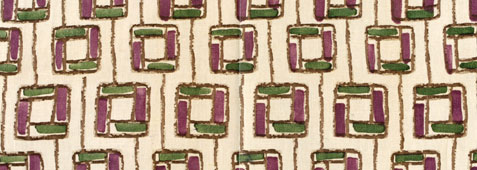
 
 
Their second book for the season is Greenbanks by their favourite author Dorothy Whipple.  I'm a bit behind in my Whipplewending; I've read and loved Somewhere From a Distance but the others are still waiting patiently on my shelf. However, Greenbanks is the story of an ordinary English family both before and after the First World War, and that immediately piques my interest.

Finally, Persephone continues to bring back into print some wonderful cookbooks. Dinner for Beginners by Rachel and Margaret Ryan was first published in 1934 and contains 109 recipes and 28 menus to cook dinners for four people. 


The bookmark I received with the magazine (this gorgeous fabric designed by Duncan Grant) had a snippet on the back in which the authors take you minute by minute through the cooking process telling you exactly when to complete each step.  Now, I've never actually attempted any recipes from my Persephone cookbooks, but oh, how I love to read them!  They are endlessly entertaining, and so evocative of the historical period in which they were written.  Kitchen Essays by Agnes Jekyll remains one of my favourite Persephones.

I'll be going to London next month and will definitely be stopping by their lovely store to pick these up along with Midsummer Night in the Workhouse, a collection of short stories by Diana Athill, and The Sack of Bath by Adam Ferguson.  That should bring my collection up to date and provide some wonderful holiday reading.

Wednesday, 19 August 2009

Added to the reading pile: More fascinating women's lives. . .

So my biography/memoir pile is growing. I have new biographies of Storm Jameson, Elizabeth Taylor (the author), Frances Partridge and Jean Rhys beckoning me. And now I've added Evelyn Sharp: Rebel Woman 1869-1955 by Angela V. John to the list. Her life touches on areas of this historical and literary period that fascinate me; she was a fairytale writer, a suffagette who was imprisoned twice in Holloway, and a pacifist during WWI, plus she had a long affair with the war journalist Henry Nevinson only able to marry him after the death of his wife, when she was sixty-three. There's a review of the book at the Times Higher Education site here. I also ordered Sharp's own autobiography, Unfinished Adventure, which Faber & Faber has reprinted through their Faber Finds series. Not sure which to read first - I may go with the biography first to get an overview and then get lost in Sharp's own voice. Or should I approach the writer first without any autobiographical preconceptions and then read the analysis? It's a tough call.


I can also hardly wait to read The Practice of Her Profession: Florence Carlyle, Canadian Painter in the Age of Impressionism by Susan Butlin. My favourite painting in the Art Gallery of Ontario is Carlyle's The Tiff and I've long been wanting to see other examples of her work (turns out a good number of her paintings are in the Woodstock Art Gallery, so a road trip is imminent). Lots has been written about the Paris art scene at the turn of the century - it will be wonderful to read about the experiences of a spirited Canadian woman among them. I've already spent a rapt hour just gazing at the colour plates of some of her other paintings and my admiration for her work has only grown.

Tuesday, 9 December 2008

New on my shelves. . .

Here are a bunch of mostly new, mostly non-fiction books I've recently acquired for the "era shelves" and that I hope to dip into over the holidays.

Survivors' Songs: From Maldon to the Somme by Jon Stallworthy. I like the premise of this book - setting WWI poetry in the context of historical war poetry and I think this will prompt some new thinking about Owen, Sassoon, Brooke etc.

Because You Died: Poetry and Prose of the First World War and After by Vera Brittain, edited by Mark Bostridge. I once had high hopes of doing a PhD on Vera Brittain, but alas, I had a reality rent check/cheque. I still try to read everything I can on her and while I've never thought her poetry particularly strong, this volume has some excellent essays and a lot of photographs that I'd never come across before. And because the Stallworthy doesn't discuss women poets at all.

West End Women: Women and the London Stage 1918-1962 by Maggie Gale. I first got interested in female playwrights during the early part of the 20th century when I was studying the suffrage movement and the work of writers such as Cicely Hamilton. Clemence Dane is another playwright whose work I enjoy and whose play Wild December I encountered while writing a paper on how plays about the Bronte sisters' lives was all the vogue in the 1920s. Dane was also a good friend of Noel Coward and is said to have inspired Madame Arcati, in his play Blithe Spirit (I love it when all my various interests come together). So I definitely need to know more about this time and I'm sure this book will have me scurrying to find copies of plays now relegated to dusty obscurity.

Her Naked Skin by Rebecca Lenkiewicz. This is a contemporary play about British suffragists imprisoned in Holloway in 1913. The play got mixed reviews when it was running in London but I still want to read it. It will be interesting to compare it with the text of a play that I did see in Toronto - Linda Griffiths' Age of Arousal - loosely based on George Gissing's The Odd Women.


And finally, keeping with the theatre theme, I've also got a copy of Michael Holroyd's A Strange Eventful History - his new biography of Ellen Terry, Henry Irving and their various troubled offspring. I love Holroyd's writing; his biography of Lytton Strachey really made an impact on me about fifteen years ago when I read it. I'm particularly interested in learning more about Terry's daughter Edy Craig who was a member of the Actresses' Franchise League along with Cicely Hamilton and who founded the feminist Pioneer Players theatre company.
One book leads to another, which leads to another, which leads to another. . .

Monday, 25 August 2008

Votes for Suffragettes. . .

When I was recently visiting Niagara-on-the-Lake to take in some plays at the Shaw Festival, I wandered into the British shop on the main road, to stock up on Jaffa Cakes and Twiglets. The store also has a good selection of DVDs and I picked up The Suffragettes. It's only about an hour long and thus basically just skims the topic. Still, it shows how ghastly the force-feeding was in the prisons, and it's quite difficult to watch Emily Wilding Davison's death when she throws herself in front of the horse at the Derby. Actresses play the Pankhursts and other suffragists and there's a tiny bit of scene from Shaw's Press Cuttings. A good introduction to the topic - I imagine it would be useful for students. Much more powerful is the Upstairs Downstairs (one of my favourite television series) episode in the second season, when Rose the maid, tries to stop Elizabeth - her naive upstairs mistress who is dabbling at being a suffragette almost out of boredom - from getting into trouble with the law and ends up being arrested instead. Rose's experiences in prison are frightening and heart-breaking.

These brave women are true heroines of mine - discerning readers may have noted that the colours I've chosen for this blog reflect the purple (for justice), white (for purity) and green (for hope) of the flags of the Women's Social and Political Union - one of the main organizations in the fight for women's votes.

There would definately be a section in my bookstore devoted entirely to histories of the suffrage movement, biographies of the main players and plays and novels that explored the issues and/or were written by suffragists. Broadview Press has kept a lot of these books in print. They've published a wonderful anthology entitled The Literature of The Women's Suffrage Campaign in England, edited by Carolyn Christensen Nelson, that includes articles making the case for and against suffrage, eyewitness accounts from the memoirs and writings of the suffragists themselves and selections of suffrage poetry, drama and fiction. They also specialize in New Woman fiction of the era, having also published The New Woman Reader also edited by Christensen Nelson, and novels such as Suffragette Sally by Gertrude Colmore. At the end of this month they are bringing out Prisons and Prisoners - the memoirs of Constance Lytton, a member of the aristocracy who pretended to be a working class woman to call attention to the differential treatment that women of different classes received in the prisons.