Showing posts with label British sheep. Show all posts

Friday, 9 November 2018

Dyeing For Colour. . .

Last month, I attended a really fun workshop at Ovis Yarns in Liverpool.  In celebration of Wool Week, we got to test out acid dyeing on mini-skeins of different breeds of British wool, finishing up with the chance to dye a larger quantity on our favourite base.

There are lots of different techniques to hand-dyeing;  we dipped, painted, splashed, speckled, and smooshed the dye - both in powder and liquid form -   onto our wool.  Below is a mini-skein of Wensleydale that I dyed.  Once you are happy with the result, you wrap it up in clingfilm like a sausage and put it in the microwave to set.


And this was the finished result. The setting softens the colours and brings out more depth.  I was very happy with my efforts.


We dyed a mini-skein of Jacob - the natural brown of the wool  goes really well with the greens.


And this was a mini-skein of superwash Bluefaced Leicester.  I'll admit to going a little bonkers with all the colours, but it'll make a nice contrast toe or cuff on a pair of socks. 


I wasn't at all happy with my initial attempts on this mix of Bluefaced Leicester and Masham - I was going for teals and mustards and it ended up becoming a really insipid limey-yellow.  So I overdyed the lot with a mossy green and it turned out fabulous!


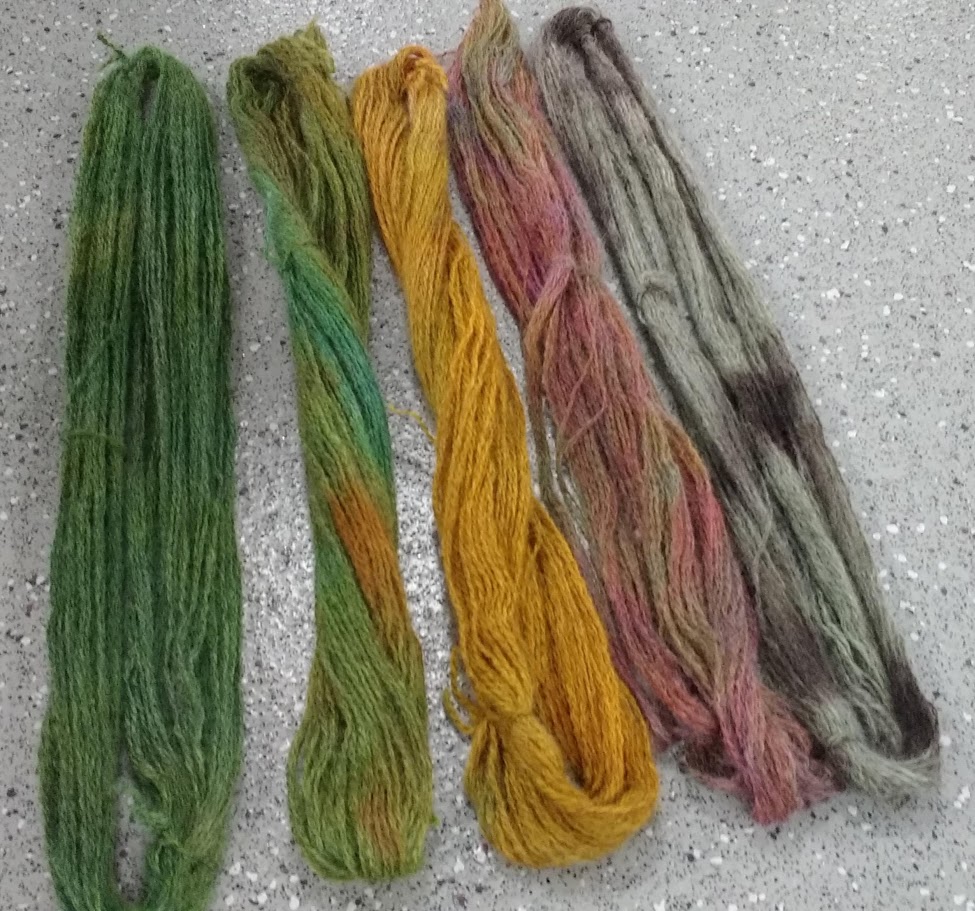
Practice skeins completed, we were then let loose on some full 100g skeins of 4ply. I had ordered a few extra skeins of the BFL/Masham blend (my favourite) in advance to get a garment quantity. I really wanted to try speckling and though it looked okay initially . . . 


. . . a little of the powder goes a long way.  It got too squished in the rolling stage and when it was set, it came out more variegated than speckled.  I still like the colours though and I think these are destined for a striped garment of some sort.  I have several undyed skeins of BFL/Masham in my stash. 


Then I tried to replicate my mossy green practice skein, but dyeing is a precise recipe and this was as close as I could get. I am still pleased with them however - I did get the deeper greens in places, and I quite like the hints of turquoise and yellow that pop out every so often.  I think I will turn these into a summer top and alternate the skeins while knitting. It will be fascinating to see how they knit up.


There were five of us in the workshop and part of the fun (apart from getting to know some very friendly and inspiring knitters), was seeing all the different colour combinations that we came up with. We all had very different palettes and were drawn also to different styles of dyeing.  These group shots do show however, the similarities in tone and undertone that the different sheep breeds offered.

Jacob:


Wensleydale: 


BFL superwash: 


BFL/Masham: 


But my absolute favourites were these gorgeous skeins dyed by Jane. They look so professional and she nailed the soft autumnal colours that she was going for.  I can't wait to see these knitted up.


If you are in Liverpool, do check out Becky's workshop schedule here.  She's also starting to offer drop in dye sessions where you can bring your own skeins or purchase some from her.  I will conquer those speckles yet!

Tuesday, 7 August 2018

The Lovely Langdales. . .

Despite my many trips to the Lake District, last Sunday was my first time walking among the Langdale Pikes.  It's an area that my walking group regularly frequents (and now I know why!) but we had always been busy whenever it came up in the schedule.

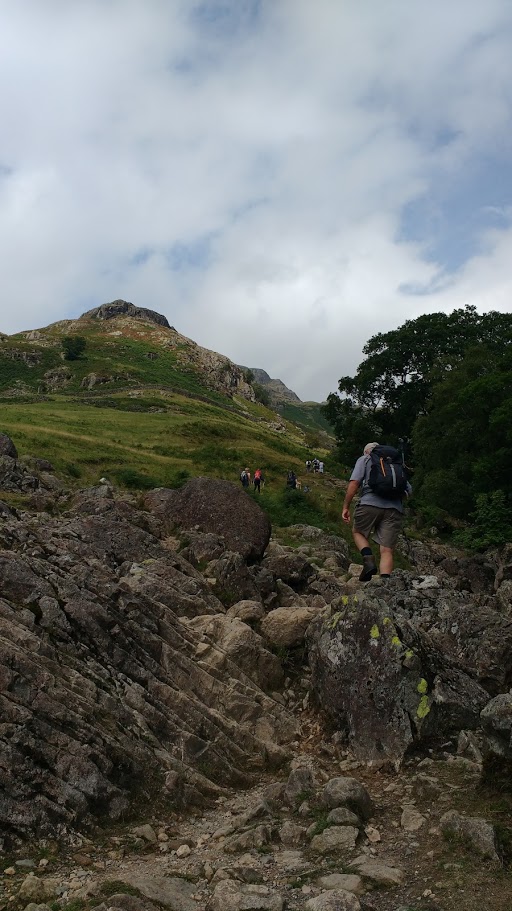
And all I can say is WOW!  This is a post where really all the photos can speak for themselves - we had perfect weather and perfect views. It was a circular walk about 8.5 miles.

From the National Trust parking lot, it was straight up into the climbing, but on a very good, stony-stepped path.  You can see how popular this area is - almost all the paths we went on were well-maintained.


This is about halfway up looking back on the valley. The path follows Stickle Ghyll.


And ends up at Stickle Tarn.  At the opposite end is Pavey Ark and there is a diagonal scramble of a path called Jack's Rake. My partner went up that, but he was on the harder walk - I don't have a head for prolonged scrambling so was happy to just skirt the tarn.


We then started heading up Harrison Stickle with lovely views looking back on the tarn.  You can also see Lake Windermere in the distance.


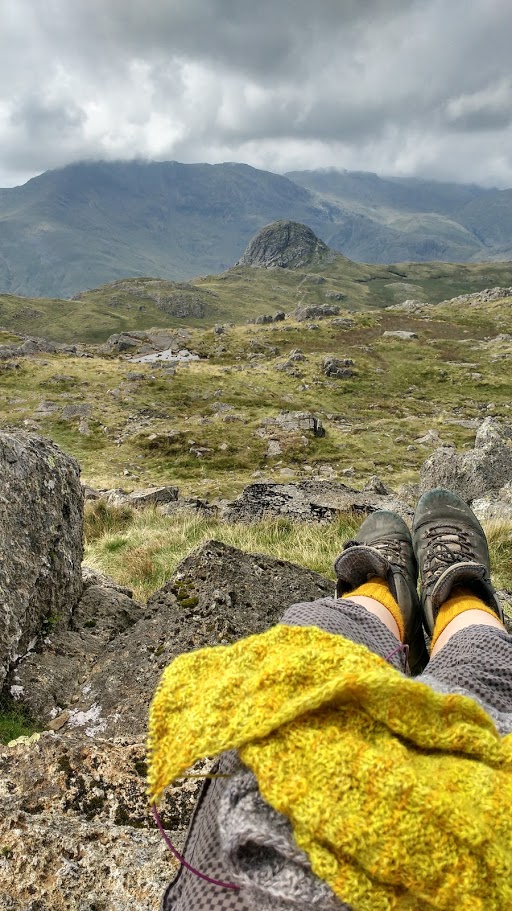
At the top was time for a break and a bit of knitting. That little round knob of a hill in the middle is Pike O'Stickle which we headed for after lunch.


It looks a little bigger as you get closer.


This was one of those walks where you had spectacular views in every direction. Here on the top, you can just see the top of Great Gable disappearing into the clouds with Green Gable beside it. 


Looking back on Loft Crag.


We then descended over glorious moorland with spectacular views in every direction - you can see Skiddaw in the distance.


I love the dramatic play of light and shadow on the landscape. It was such a stunning day out in the hills.


We then came across these huge bags full of Herdwick fleece.  My guess is that it'll be used in much of the path repairs taking place in this area. The wool forms a good barrier between the bog and the stone path.


Finally we swerved around and returned back along this valley path.  Definitely a walk for the top ten list!


Thursday, 17 December 2015

A Sheepy Xmas Tree. . .

I have not had a proper Christmas tree since I moved to Liverpool.  The Liverpud had a little tinselly tabletop tree that, once plugged in, changed colours from the most garish of purples and pinks to slightly less offensive blues and greens. We both decided we couldn't stand looking at it for another year.  The problem is that, having always had real trees as a kid in Canada, I've never warmed to plastic boughs.  So what to do?  A bunch of branches in a large vase?

The solution came when I was passing an arts supply store. They were having a 50% off sale on artist easels, which of course are made of wood, fold out into the perfect triangular tripod and best of all there are no needles to clean up.  I bought a bunch of long screws and wingnuts to create hooks for the decorations and ledges for the lights. A few strands of white fairy lights later, and we had all we needed to get cozy against the early dark nights.

But what REALLY makes my tree this year are these fabulous sheep decorations from The Knitting Goddess. 


The sheep bodies have been screen-printed from various knitting stitch patterns onto white felt. The kit comes with two sheets; you simply draw a circle around two sheep, stitch them up (I used blanket stitch with various leftovers from my British breeds swatch-along), stuff them, crochet a little hook and you're done.  Don't they look terrific?  And they work perfectly with the light wood of my "tree".


At the time of writing, she still had some sets left on her site. All proceeds are going to charity so you'll also be supporting some wonderful causes.  I think some British Breed wool pom poms are the next thing I need to make.

Monday, 7 December 2015

In Praise of the Swaledale. . .


Here's my next finished British Breeds swatch.  It's knitted in Swaledale wool from Swaledale Woollens.


I have a lot of love and good memories tied up with this breed, as part of the Coast to Coast walk involved going through the lovely Swaledale Valley where you can visit the village of Muker where this wool was bought.


The landscape is patterned with these lovely fields surrounded by Yorkshire drystone walls and of course you see the Swaledale sheep everywhere.


I chose "Sheepfold" in Barbara Walker's Second Treasury of Knitting Patterns for my swatch as it reminded me of these fields.


The yarn is really great to knit with; it's wonderfully crisp and creates a soft but strong fabric (I wore it against my skin for a day and practically forgot it was there).  The stitch definition is also terrific as you can see, and it would make a fabulous cabled jumper.  I ordered enough to make one,  and just need to find the perfect pattern now.  I also love the silvery-grey colour.

Monday, 16 November 2015

Wovember and the Great British Breeds Swatchalong. . .


It's the middle of Wovember - the month dedicated to all things pure woolly - and there have been so many amazing posts and photos up on the Wovember website that really explore the breadth and depth of what wool and sheep means to farmers, dyers, spinners, knitters, and creators of all types. It's all very, very inspiring and informative.

I've embarked on my own woolly project of exploration and celebration, participating in the Great British Breeds Swatchalong organized by Louise Scollay of Knit British, who is passionate about British wool. Knitters across the UK (and the world actually) are knitting up swatches of either British or local breeds.  We have to use single breed and undyed wool, but the stitch pattern is up to the individual knitter.


We then put each swatch through its paces and write up detailed notes at every step.  We squish the skein, we note how each yarn feels while knitting, and we observe the characteristics of the unwashed swatch. Then we soak and block it, spend a day wearing it against our skin, rub it for a fuzz and pill test, and then wash and block it a second time.   Louise wrote up an excellent set of guidelines and FAQs here.  There is no deadline and you can apply the same routine to any wool local to you.  It's all about getting to know a local yarn really well, opening your knitting stash to breeds and small, local suppliers you may not have previously considered, and really thinking about where your yarn comes from.


So far I've finished four swatches which are, starting at the top left and working clockwise:  Herdwick, North Ronaldsay, Gotland and Norfolk Horn.  For my first two swatches, I just knit a random combination of stitches, but then I thought I'd really like to end up with a beautiful blanket of all my swatches, so I'm now trawling stitch design books for inspiration.  I love quilt blocks with names that tell a story, so I'm trying to pick designs that either seem to fit the yarn or have some personal meaning for myself, which can be as frivolous and fun as a stitch pattern called "croissants" that I came across recently ( my favourite weekend morning treat with a cuppa and the Guardian - and I think I may have the perfect naturally coloured wool for this!).  For the North Ronaldsay swatch, I used a square called " A Little Bit of Scotland", out of the book Knitting Counterpanes by Mary Walker Phillips.  This breed live on one of the northern Orkney islands and eat seaweed.


For my Gotland swatch, I used a Barbara Walker stitch pattern called "Northern Lights" as the breed originates from Sweden.

So far, I'm really enjoying this process.  I find that the yarns are vastly different, not only in terms of colour and texture and smell, but in how they change (or don't) after blocking.  It's also quite fun to try and collect a sample of each breed.  Yarndale was a great starting point.


But my bag is now overflowing. I currently have about 25 different breeds which, given that each swatch easily takes a week to fully test, should keep me going for some time.


Many of my balls have come from Blacker Yarns which sells a wide variety of different single breed yarns.  But one of the joys of this project is to discover lots of different, indie producers, often just making yarn from their own flock of sheep. At Yarndale I had a great chat with the folk from Gam Farm Rare Breeds and saw one of their Whitefaced Woodland sheep.  They are located near Grassington in Yorkshire, where I've gone walking in the past.  I love knowing that I've tread the same gorgeous landscape as the sheep whose wool I'm knitting. In many cases it's also the sheep who have made that landscape over generations.


Herdy sheep who roam freely over the Lake District are a favourite of mine, which is why I started with a Herdwick swatch.  And while I knew it wasn't going to be the softest of yarns, it definitely wasn't as coarse after washing as I'd anticipated. And it is really strong and sturdy - perfect for a pair of waterproof mitts that I'm planning.


I also discovered  Crookabeck Farm near Patterdale in the Lake District.  They raise Herdwicks and Angora goats and have combined the two to create a yarn that is 50% Herdy and 50% mohair.  I've ordered a skein and will be really interested to see how the mohair softens the wool.  The farm also sells yarn from the Red Fox breed originally from Germany.  A ball of this has also gone into my bag; even though it's not a British breed, the actual sheep it comes from is raised in the U.K. so I think it counts.  Swaledales also hold a place in my sheepy appreciation heart, mostly from the beauty of the Swaledale valley in Yorkshire which we walked through as part of the Coast to Coast walk.  In the tiny town of Muker is Swaledale Woollens where you can purchase wool or knitted garments from the Swaledales.  And I've also bought a skein of Texel wool from Orkney Wool.  I squealed when it was delivered - so squishy and bouncy.

So this is a big and long term project, but one that I'm sure is going to be fascinating and very rewarding. And I should end up with a gorgeous blanket by the end of it.  Here's my latest swatch knitted this weekend in Pure Cotswold.  Somehow white wool cries out for lace, so I've done some simple repeats of a Twin Leaf pattern.


Monday, 12 October 2015

Addicted to Sheep Documentary. . .

I saw Addicted to Sheep over the weekend and keep thinking about it.  The documentary follows a year in the life of the Hutchinsons, a family of farmers and sheep breeders in the North Pennines.  It's a hard life with little pay or security, especially if you are a tenant farmer, and the work is unrelenting.  I'm always walking by fields of sheep and thinking they look so relaxed, carefree and self-sufficient, munching away on the grass, but this film really shows how much human intervention is needed; they are always being rounded up and checked for illness or pregnancy, or to be tagged and sheared, or to be fed during the winter months. The Hutchinsons deal with everything in their stride (including difficulties during lambing season), and with a good deal of humour.  Their children are really grounded and there are some very funny scenes shot at their school where all their classmates also live on a farm.

It was eyeopening, especially in conjunction with blogposts that I've recently read such as this, that point out the plight of British sheep farmers and how little they receive for their wool.  It makes me think about the yarn that I use and has really motivated me to explore as many different British breeds as I can.  I'm participating in KnitBritish's breedswatchalong and will post my progress as I go along. I love British sheep and I know I'm going to love branching out and seeing the different woolly characteristics produced by different breeds.