Thursday, 10 March 2016

The Yarn Whisperer Goes to Knitlandia. . .

I have all three of Clara Parkes' reference books in my library -  The Knitter's Book of Yarn,  The Knitter's Book of Wool and The Knitter's Book of Socks - and I refer to them regularly, particularly the first two.  I've also been a subscriber to her popular The Knitter's Review newsletter for years (definitely sign up if you haven't already).  Her knowledge and passion for knitting and all things fibre related is impressive.  So with her new book Knitlandia: A Knitter Sees the World out last month, I thought it was high time to read both of her essay collections focusing on different aspects of the knitting world.

I've come across several recent books that have writers reminiscing about favourite garments and the memories associated with them but in The Yarn Whisperer: My Unexpected Life in Knittting, Parkes takes a slightly different approach, by looking at how the actual process of knitting different stitches, using various techniques and simply being a knitter can also provide plenty of "madeleine" moments of memory and retrospection.


There are twenty-two autobiographical essays, each just a few pages long and easy enough to dip into when you have a spare minute.  Great for bus or train commutes to work.  And in small doses is perhaps the best way to tackle this book because the metaphors can at times feel a little forced. I enjoyed her essay comparing a yarn stash with a garden - the planning, the potential, the mistakes and the need for what she calls "prudent weeding"  - and one on the meditative and practical similarities between playing music and swatching.  The art of baking and knitting, both involving your hands and the following of recipes is ideal raw material for a comparative essay,  although I'm not sure I'd agree that making a croissant from scratch which she terms the "perfect knitted pastry . . . a product of slow, steady patience",  can really be equated with the rather fast and easy stockinette stitch .  And the essay on mystery novels and with good and bad fictional characters finding their counterparts in knitting patterns just didn't really work for me.  Some of the writing felt like filler as did the design of the book in which the entire first page of each chapter is several font sizes larger than the following text. So I did find this book a little disappointing.

However, I absolutely LOVED Knitlandia: A Knitter Sees the World.


Here Parkes is in her element, a keen observer and appreciator of the many global adventures that her knitting has taken her on.  I've gone to enough yarn festivals in the UK to know that each has its own character and vibe, partly from the venue and location, but also because different organisers have different visions and the mixture of vendors and events is never the same.  I've never been to one of the huge U.S. shows such as Rhinebeck or the Maryland Sheep and Wool Festival, but I do feel now as if I've travelled vicariously through Clara's essays.  One of the largest industry shows she describes is TNNA, where if a knitter accidentally stumbles into one of the "stark, canvas-lined needlepoint aisles . . . a distinct chill comes on, a sense of having left one's village and entered a strange forest." I'm unlikely to ever attend TNNA, but many years ago when I was a bookseller, I went several times to BookExpo America which seems to have many of the same traits.  Only in my day, veering into the self-publishing aisles was the scary experience, especially if the subject was new-age or cosmetic surgery.  Self-publishing - certainly in the craft world - has come a long way since.

Aside from shows, there are also recountings of retreats and knitting holidays.  One of the best essays in the book is titled "Naked Lopi" where Parkes travels to Iceland along with a coach of mostly American knitters for a series of workshops and tours around the country. She gets a lot more (beyond the yarn and there's plenty of that around), than she bargained for and learns to abandon quite a few personal inhibitions.  Similarly at the Squam Art Workshops held at a lake resort in New Hampshire, she overcomes her skepticism about having to do meditation and the "woo-woo" qualities of some of the themes, to embrace instead the "magic" that the woods and nature can bring to the creative spirit.

These essays were great armchair travel reading around a theme that all crafty people can relate to, even if we're on the perpetual student side of the experience rather than the all-knowing teaching side. And for those readers in the UK, her essay on her first visit to Scotland and the 2015 Edinburgh Yarn Festival is essential reading - for the recognition and celebration of how far the local wool industry has come in the last few years, for the encounters with familiar designers, vendors and bloggers and for the astute observations as to why a festival such as this differs from American ones. I felt quite proud reading it, proud that she, "felt no elbows, and saw no greedy grabbing of skeins, no hoarder hustle to beat me to the next booth." The whole experience reminds her that no matter where in the world you are, knitting, "has a profound connective power. The culture and people and rituals around it, the values, they all contribute to an immediate and profound trust in one another. It's home. You belong and are accepted, which rings true no matter where you are."

This last observation is something I will remember next week when I'm in Edinburgh and if you are travelling up to the festival,  Knitlandia would be the perfect companion.  Just in case you accidentally forget the knitting at home.

Monday, 7 March 2016

On the Needles for March. . .

I've been nursing the inevitable cold I seem to get each March.  It attacks each of my colleagues in turn and just when I think I've become immune to all the workplace germs, I wake up with that tell-tale tickle in the back of my throat.

So I spent most of the weekend taking naps and lying on the sofa accompanied by lots of cups of tea with honey. At any rate, it has allowed me to get a lot of knitting done.

I had such fun last year with Kate Davies' Seven Skeins club that I decided to join another yarn club for 2016.  I chose Ysolda Teague's club as she uses all British yarns and hand-dyers. I received my first package last month - a gorgeous skein of deep emerald Blue-faced Leicester lace-weight, dyed by Triskelion Yarns.  The accompanying pattern is called Banyan which can be knitted either as a shawl or a wrap.  It's tricky combination of lace and cables, but the end result when blocked should be wonderful.  It's a LOT of knitting though; six 80 row pattern repeats plus some extra rows at the end.  I'm on the fifth repeat and really hoping to have this finished in time for the Edinburgh Yarn Festival.  It will go perfectly with the dress I plan to wear at the ceilidh.


It's all squishy now, but should block out to a very beautiful lace pattern.

The other project in the works is Solja, designed by Anna Maltz.  I've admired this sweater ever since I saw it in Pom Pom magazine.  Many of the versions that have been knitted are in bright, bold colours but I'm going for a more muted palette.  I'm using Baa Ram Ewe's new DK yarn, Dovestone. The body is knitted in the natural shade of Yorkstone with Bramley Baths as the first contrast colour.  I love how the pale blue looks against the soft grey, even though I'm not usually that keen on pastels.  I haven't yet decided on the rest of the colours.  One part of me is toying with the idea of using the Bramley Baths for all of the colourwork; another idea is to use varying shades of blue from my stash.


I've just completed the body up to where it gets joined with the sleeves. Two sleeves to go before I need to think about the yoke.  This yarn is wonderful to knit with - so soft, but rustic at the same time,with less of a halo than Titus.  It's interesting to see how the two yarns take the same dye colours differently.  The Dovestone has taken out the alpaca of Titus and added in 25% dark brown Masham to the Wensleydale and Blue-faced Leicester blend and it gives it a bit more of a heathery look. I'm looking forward to creating a really cozy sweater - perfect for future sick days on the couch.

Wednesday, 2 March 2016

Buchanan In Nature's Shades. . .

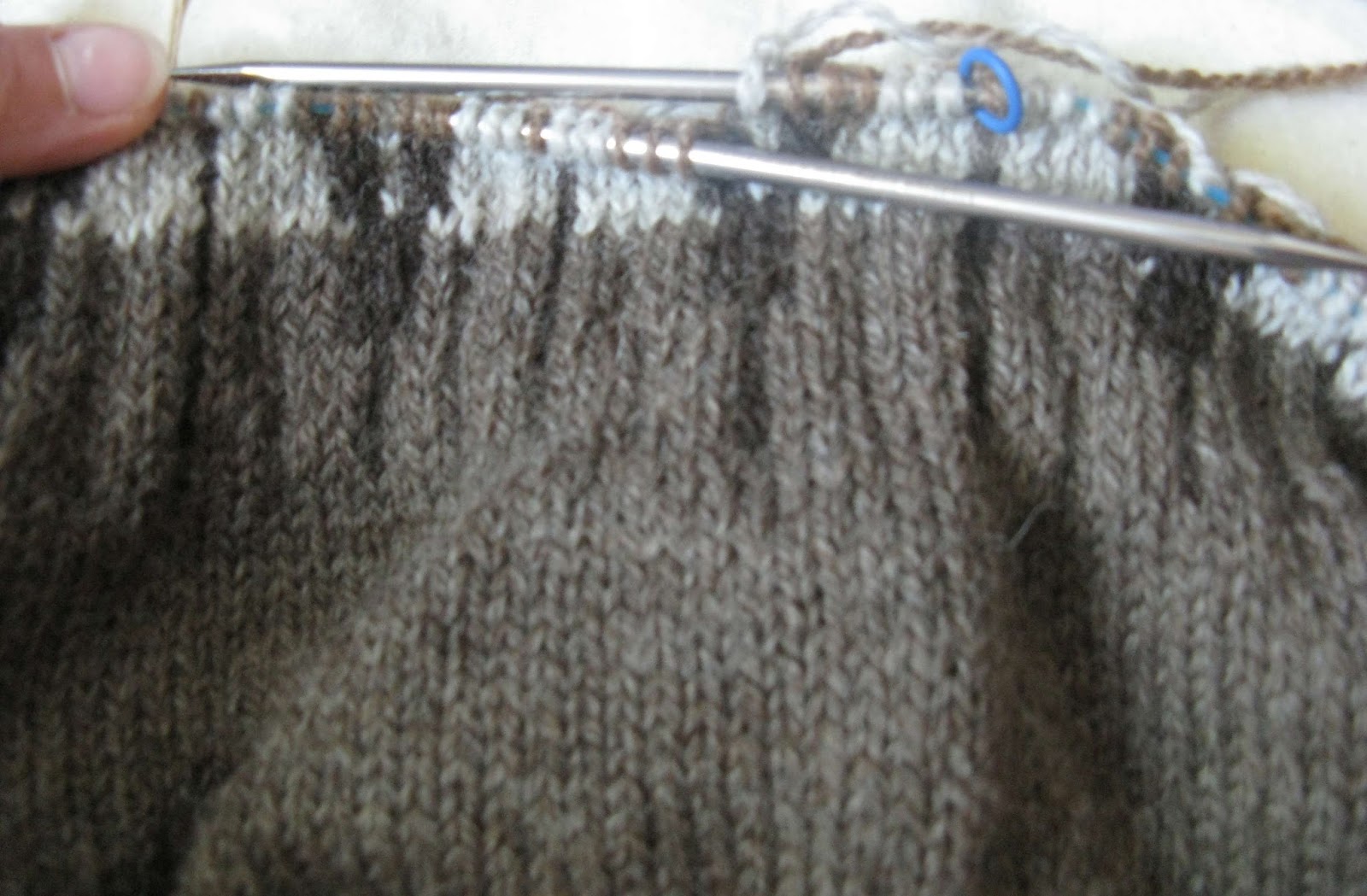
Here's my finished Buchanan, designed by Kate Davies and knit as part of Knit British's Nature's Shades knit-a-long.


When the idea for the KAL was proposed, I thought it would be really interesting to pick a pattern that had originally been designed with lots and lots of colours. I looked at Kaffe Fassett's patterns (too much intarsia) and some of Marie Wallin's gorgeous fair isle sweaters (too many shades) but in the end, I went with this lovely short-sleeved top by Kate from her Yokes book. You can see the original bright colours she used in her version here. 

I knit this entirely with stash yarn  (hooray, although it barely makes a dent).  The body is Rowan Purelife British Sheep Breeds Blue-faced Leicester, and there's Manx Loaghtan and Falklands Island wool in the yoke, both from Blacker Yarns.  The band of light grey is Kate's own Buachaille yarn which I really wanted to use; I'm such a fan of both the yarn and her designs. 


The pattern was very easy to follow and I love the fit.  In retrospect, I should have paid more attention to the yoke and the weight of the yarns used.  I should have held the dark brown Falklands doubled as it's a 4ply up against the sportweight of Buachaille.  It does fade into the background, especially on those single vertical lines.  But I'm very pleased with the body which is soft and lovely against the skin, and I think this is a top that will be perfect to wear in the transitional seasons.  The colours do say autumn to me, but you can bet I'll be wearing it a lot this spring.

Friday, 26 February 2016

Tamar and Gwindra: New from Blacker Yarns. . .


Take a moment just to look at the COLOUR of the above swatch.

It has such depth.

It almost glows as if it had silk in it.

But this swatch is actually knitted out of 100% British wool.  This is Tamar, the new blend from Blacker Yarns.  Now I've been a huge fan of this company for several years.  I have always admired their dedication to promoting British breeds and supporting small farm producers and their yarns are gorgeous; I've always enjoyed knitting with them.  So when the call came out on Ravelry for volunteers to review Tamar, I jumped and emailed them right away.   Sonja sent me a small complimentary skein of the 4ply, (Tamar also comes in a DK weight), in the colourway Kensey.  All opinions on this yarn are of course my own.

I have been using some Blacker breed specific yarns in my British breeds swatch-a-long and I've already swatched with two lustre breeds - Cotswold and Black Leicester Longwool.  So part of the appeal of Tamar was not only that those two breeds were part of this blend, but it also included Wensleydale and Teeswater (both waiting to be swatched in my British breeds stash).  I have at least hand squished all four of these breeds and they are soft and silky and luscious and putting them all together in one blend along with 30% Cornish Mule to give it strength and bounce, is simply ingenious.

I loved knitting with this yarn.  It flows through the fingers but is very soft.  There is a slight halo to the yarn which remains even after washing and blocking, but as you can see from the photo, this doesn't detract from the stitch definition.  A comparable yarn in terms of the feel and halo, would be Titus from Baa Ram Ewe, which also contains mostly Wensleydale, but adds some alpaca to it.  There is no getting away from the Tamar glow though, and that is what makes this an exceptionally beautiful yarn.   I knit the above swatch in the recommended 4mm needles which I think is the perfect size for garter stitch giving the rows enough spring and stretch. If I were doing a garment in mostly stockinette, I'd go down to 3.75mm or even 3.5mm to create a firmer fabric, but that's just personal preference.

Close up, you can see that Tamar would work fine for lace ( I could have blocked it a little more aggressively) and for textured stitches, while they may not pop as strongly as with other yarns with shorter fibres, the cables are definitely pronounced enough.


I wore the swatch next to my bare skin for an hour and barely noticed it was there.  This would be a really suitable yarn for almost any type of project, but especially one where that extra coziness is called for - hats, mittens, cowls, shawls and socks. I definitely want to knit a sweater in this yarn, possibly one with colourwork.

The Tamar palette is one of the things I most love about this yarn. There are 17 shades in all, available for both the 4ply and the DK weight, including two natural shades -  Gwindra, which is a silvery grey, and Ottery which I'd still call a light grey, just a shade or two up in intensity from Gwindra.


I took the above photo of the shade card outdoors and it's pretty close in colour to the actual card I have in my hand.  I'm absolutely crazy about this muted, heathery palette and how well each shade fits, not only against the natural colours, but against the shades within their own colour family.  Look at the four blues, for example. And the three (count them!)  gorgeous purples.  I especially like Valency, which is pale mauve-lavender mix that in certain lights can look more purply, or more grey. It could serve either as a very versatile neutral colour,  or part of a gradient of colours going from the purples right into the greys.  Blacker then throws in a shade like Tiddy Brook - that bright pop of yellow on the right hand side.  Put that next to the aqua blue of Tresillian or the dusty rose of Kensey and suddenly you have a really vibrant and fun combination of colours.

Blacker Yarns will be launching Tamar on March 3rd and it will then be available on their website here.  They'll also be bringing it to the Edinburgh Yarn Festival which I think will be the hit of the show.  I know I'll certainly be buying a few skeins.   Brityarn will also be stocking it.  It's amazing to think that as beautiful as this yarn is, the sheep breeds involved - Teeswater, Wensleydale, Cotswold and Black Leicester Longwool - are all listed as either "at risk" or "vulnerable" by the Rare Breeds Survival Trust.  So kudos to Blacker for supporting the farmers who are trying to keep these breeds alive and relevant, and showcasing the sheep's qualities by creating this beautiful yarn.

Blacker will be creating patterns for Tamar and I also volunteered to test knit the Gwindra Shawl, designed by Sonja Bargielowska.  The Tamar swatch I knit above uses the cable and lace stitch pattern that is found on the edging of the shawl.  For the test knit however, I decided instead to use some other Blacker yarns from my stash.  The main body is knitted in Cornish Tin, their limited edition tenth anniversary yarn.  I snapped up three skeins at Yarndale last year and it was perfect for this shawl.  It's knitted on 5.5mm needles with lots of texture formed by the garter ridges.  I added some Polwarth and Ryeland on the last three pattern repeats to inject some bold stripes and I love how the natural shades play off each other.


The deep lace and cable edging was a lot of fun to knit and really anchors this shawl nicely.  It's big and cozy, whether wrapped around my whole body or just the neck and shoulders.


The pattern is free and can be found here.

Thanks to Sonja and Blacker Yarns for allowing me this sneak preview.

Sunday, 21 February 2016

Unravel, The London Craft Guide and some 5,000 Year Old Wood. . .


On Saturday, I got up at an insanely early hour to get down to Lime Street station in time to catch the 5:47 train to London.  Thank goodness the coffee shops open at 5:30am.  Still, even fully caffeinated, it's never a good idea when half asleep to start a complicated lace pattern on a moving train.


This is the start of what will hopefully be a gorgeous lace and cable wrap.  I foolishly thought that with 6 hours of train time, I'd get the first repeat of the chart (80 rows) done.  After making mistakes and having to rip back, I ended up with only eleven rows completed, which nonetheless felt like a great victory.  That's only 494 rows left to go.  Sigh.

Anyways, after arriving at Euston,  jumping on the underground for the quick trip to Waterloo and hopping aboard another train, I made it to Farnham around 10am.

A short, pretty ten minute walk from the station gets you to Farnham Maltings, the annual site of Unravel, yes, yet another U.K. yarn festival.


The set of buildings is quite cool - they normally house a theatre and several craft studios and if you look at their monthly calendar there are tons of interesting courses, exhibitions and events happening on a regular basis.


I wasn't entirely sold on the venue for a crowded yarn fair, however.  It definitely has its charms in that it's a bit higgledy-piggledy; you walk into one room of exhibitors, which leads into another. A set of stairs takes you to another room and in an annex of that, are more vendors.  Then you make your way to the basement - yet more to see - and in various alcoves and display cabinets along the way are examples of work by textile artists.  Oh, but don't forget the platform at the back of the Great Hall and the vendors tucked away behind the back wall.  The organisers do produce a good programme with a map of all the rooms and a list of corresponding vendors, but it's still very easy to miss some.  And when it gets crowded - as it did about an hour after I arrived - it's really hard to move between and among the tiny rooms.

I only really managed one photo so as not to jostle or be jostled, but it was for one of my favourite booths - The Little Grey Sheep.  I first came across them at Yarndale and bought a skein of their hand-dyed Gotland yarn.  They have the most gorgeous yarns from their own flock of sheep in Surrey and under the photo of Jose, is a display of their mini-skeins.  I bought five luscious, beautiful, deep colours that I'm sure I'll use in a future colourwork project.


Down in the basement was another vendor on my must-see list.  IST Crafts.  I am always in awe of people who work with wood and so I treated myself to a hand-turned Turkish spindle made out of English bog oak that is over 5,000 years old!  How special is that?  I love it.  Yes, I know I haven't yet mastered the art of drop spindling, but I have an upcoming class at the Edinburgh Yarn Festival and I'm determined to crack it.  Apparently with this spindle, when the yarn is wrapped around the bottom, you can also create a ball with a center pull. 


Another stop was at the Yarn in the City booth.  Rachel Brown and Allison Thistlewood, the women behind the annual Great London Yarn Crawl  (which I've sadly never been to,  but it's on my list!), have just published The London Craft Guide.  While similar in focus to Leigh Metcalf's London Stitch and Knit, that I reviewed in December,  The London Craft Guide also includes eleven patterns for knitting, crocheting and sewing projects.


There are fewer stores highlighted in the London Craft Guide, but such is the inexhaustive nature of the hidden treasures to be found in the big city,  that they listed one very centrally located, that had flown under the radar of Metcalf - Beadworks, near Covent Garden.


I popped in on my way home and it's a lovely, fully stocked store, with a large selection of size 6 beads (the ones most knitters use because the hole is big enough to fit a tiny crochet hook in).  I was able to find some vibrant green beads for a future project.


The Yarn in the City booth also sold yarn, including this skein of sock yarn especially dyed for them in Union Jack colours, so it had to come home with me too.


The London Craft Guide also lists a few stores in popular day-trip destinations from London - Brighton, Oxford and Cambridge - so while there is some overlap with Metcalf's guide for the London shops, there is enough new material in the book to warrant having both on the shelves. Some of the patterns are especially lovely including the Knightsbridge Shawl by Anniken Allis, the South Bank Shawl by K. M. Bedigan and Because Sock Yarn by Kate Atherley which uses up one skein to make both fingerless mitts and a matching shawlette.  I think the latter is where my souvenir skein is headed.

I didn't get home until 10pm and I've been trying to recover sleep ever since, but I'm glad I made the trip south.  I got to chat with some people who had been at Gwlana with me last year and I also got to meet my course tutor and ask her a few questions about my module.  And while I didn't stay for the screening,  I learned there's a documentary called YARN looking at global artists and knitters, which will be out later in the year.

Bring on Edinburgh!

Thursday, 18 February 2016

Modern London As I've Never Seen It Before. . .


London is a city with so many literary and historic layers to it, that you can easily spend days, weeks, wandering the streets, engaged with all the fascinating architectural detail.  And most of the tourist areas are focused in and among the city's older and magnificent treasures.

But London is also a very modern working city too, and on our recent mini-break, the Liverpud and I decided to undertake a walking tour of the financial area and get up close with some of the buildings we'd only see from afar across the Thames.  There are lots of architecture walking tours offered in London and you can pay quite a lot for some of them, but I'd recommend downloading this free guide produced by the City of London and just doing it yourself.  It took us about 2 hours and it was fascinating.

But actually, in order to get the best views of the new, you need  to climb the old.  So we started our tour at the Monument , which at 4 pounds, is one of the best tourist deals in London.


When you get up to the viewing platform, you are right among the modern buildings.  Here you can see the "Walkie-Talkie", the "Cheese-grater" and the "Gherkin".


With a great view of the Shard on the other side of the river.


Then it was off to St. Paul's Cathedral which I'd never actually been in before.  This is a bit more pricey but I thought it was worth it.  There is no photography allowed in the cathedral, but as you climb up to the viewing platform, you pass the Whispering Gallery (great fun to test out!) and then at the top of the dome, there's this tiny window in the floor which looks straight down onto the beautiful floor.  So you need to climb quite a few steps to take a photo!


You also get this view of the city.

And you can look down on Paternoster Square where our walking tour will begin in earnest.


And a reminder that the city's wealth initially owed a lot to sheep.  This is part of a statue called Paternoster by Elisabeth Frink.


I won't go through all the buildings that we saw, but here are a few that I particularly liked.  This is One New Change, built in 2010.  It uses more than 6,300 glass panels in 22 different colours.


 I love how it can just blend into the sky.


100 Wood Street takes classical Portland stone and alternates it with glass.  I like the pattern on the roof.


There's quite a trend for buildings to show the inner workings from the outside, or indeed on the outside.  I was drawn to the cheery yellow of the pipes and lifts on display at 88 Wood Street.


This is Ropemaker Place, and it has indigo-hued windows that change with the sun's position and help reduce the energy needed for cooling the building. 


And this building at Broadgate is huge!  Set back in its own courtyard of shops and restaurants, it's the kind of building you'd never come across in London unless you worked in the area. 


Lots of buildings such as the Broadgate Tower, like to feature parts of the engineering on the outside.


And the Gherkin is pretty impressive up close.

I particularly loved this kinetic bicycle sculpture by Ai Weiwei called "Forever" that is in front of the Gherkin.  From all angles it looks as if the wheels are turning.


More interesting outside cladding on the Cheese Grater building.


And the Lloyd's Building.


And you have to remember to look up to appreciate how the curves and glass in this area frame and reflect the sky and the architectural landscape. There's a strange beauty to be found among these steel boxes.


And no doubt the landscape will constantly change. I do like how London buildings are given a nickname.  No doubt we'll be back to see how "The Scalpel" looks when it's completed.


I highly recommend having a walk around this area (and there are plenty of coffee shops scattered about to keep you hydrated and energised -  I can highly recommend the pistachio macarons at Paul's).  There are hidden sculptures and quite lovely courtyards and we even stumbled on an unexpected skating rink.   We ended the day by crossing the Thames and walking along the South Bank, having dinner along the way, and then enjoying the city lit up at night.

Just remember that even with comfortable shoes, pounding the hard sidewalks is much tougher on the feet.  I was so glad our hotel had a nice big bathtub.

Monday, 8 February 2016

Three On A Sunday. . .

I'm really glad Liverpool has an indie cinema.  Having spent countless hours in Toronto's cinematheque (later TIFF), and doing the mad dash from one film to another that is the Toronto Film Festival, I've missed the adrenaline and fun of movie marathons.

FACT in Liverpool is an arts centre that includes an indie theater. Members occasionally get free tickets to preview films and while these usually are all gone before I get around to booking, I was able to grab a freebie to see A Bigger Splash which screened yesterday at 11am.  Now I love seeing morning movies, not least because it allows you to see more matinees.  So I took the opportunity to book a 2:15 movie (Youth) and the 5;30 as well (Rams).  I can't remember the last time I saw three films in a row and I thoroughly enjoyed the experience (if not all the films).


I was so looking forward to A Bigger Splash.  It was directed by Luca Guadagnino who also directed Tilda Swinton in the film I Am Love, which I thought was a terrific, stylish melodrama.  I was not that keen on this film however.  It's a remake and while I've not seen the original, La Piscine, I have seen films that dealt with some of the same themes of jealousy and generational suspicion, such as The Swimming Pool, or even Bonjour Tristesse, that were much more enjoyable to watch. The hedonism and selfishness of the characters is set against the migrant crisis, but it's no less tedious a theme even with the juxtaposition.  I will say that Ralph Fiennes gives an energetic and compelling performance that is mesmerizing to watch, but when he wasn't on screen, I was quite bored.

My second film, Youth, directed by Paolo Sorrentino and starring Michael Caine, Harvey Keitel, Rachel Weisz and Paul Dano was wonderful.  It was beautifully shot, full of arresting and thought-provoking images, tender and comic relationships between the characters, and meditations on art, the passing of time, friendship, and beauty that never felt twee or persistent.  It's easily my favourite movie of the year (yes, I know it's early) and I need to dig out that dvd I bought some months ago of Sorrentino's The Great Beauty and give that a watch.


Then there was Rams.  Iceland and sheep. I am amazed that I actually found time to read the subtitles in the midst of gazing in detail at every character's yoked sweater.  I've seen this film marketed as a comedy which I think is very misleading. It's definitely a drama with a few comic moments.  There's a family feud, two brothers who haven't spoken to each other for decades, and a disease that has hit their valley, forcing the authorities to order that all their sheep be killed. I don't want to give anything away, but there are lots of grim moments in this film, not least the weather.  Still, after a sluggish start, I really got absorbed in the lives of these two farmers and the last thirty minutes really gripped me.  Definitely worth seeing.  Just don't expect a comedy. 

Wednesday, 3 February 2016

Things Are Growing. . .

 It's starting to feel as if spring is in the air. The buds are starting to bloom on the camellia bush in the back yard.


There are new green shoots on the tiny lavender bush that I bought last summer.


My pile of swatches for my course also continues to grow.  This was a fun one to do - using one DK yarn and increasing the needle size every 12 rows to see the different type of fabric that it makes. 


There have been other swatches too.  Many, many, many, many swatches.  I have two more to go for the first module and then quite a few reports to write, but I'm very happy with my progress so far.


I've not had much time for my Buchanan, but I have started the yoke.


And this is a lovely new shawl that I'm currently having fun test-knitting.  I'm nearly on the edging which will be gorgeous.