Monday, 4 September 2017

Shetland Part 2: Knitting Then. . .

A big part of our Shetland tour involved visiting museums and getting inspired by the islands'  rich history and heritage of both fair isle and lace knitting.

We were fortunate enough to have Ella Gordon, a talented Shetland designer, join us for dinner one night. She designed the Vatsland Jumper that I recently completed. She brought many pieces of her vintage knitwear collection to show us.  I really love the jumpers done in natural shades.


The Shetland Textile Museum in Lerwick is not to be missed. It's small, but packed to the rafters with lovely exhibits.  They opened the loft area for us and we were allowed to touch and look at all these swatches up close.


We even were allowed to handle these delicate lace samples.


This is my favourite all-over pattern - birdseye. I see a long stole in my future.


I definitely won't be knitting delicate lace socks though, much as I can admire them. I love the little hap on its mini-stretcher too.


Lace fingerless mitts?  Nope, won't be knitting these either.


We also took a ferry over to the island of Whalsay where their Heritage Centre was hosting a Fair Isle Through the Decades exhibit.

I love the fair isle scarves - they are knitted in the round and then tassels are used to close the edges.  Motifs are chosen that work in both directions so you don't have to graft in the middle.  I love the subtle shading of the triangles in the scarf from the 1920s on the left.  And these pops of fair isle from jumpers knitted in the 1970s, just on the hem and the collars, is very effective.


But THIS garment was the show stopper.  The skirt can also be worn as a cape!  We challenged one of our group who was just as fascinated by the skirt as I was, to recreate a pattern for it and knit one. 


The Shetland Museum in Lerwick covers a lot more than just textiles of course, but it does have a super display of historical knitting.  I wouldn't go to Lerwick without visiting this museum - it is so well done.  Lots of museums try to find a balance between different age groups who might be visiting, and while I understand the need to appeal to children and school groups, I get a bit tired of displays always needing to be "interactive".  I like rooms to have a theme, with some appropriate information and proper labeling of the artifacts, and I was very impressed with the clean lines and interesting groupings in this museum. (There is a computer where you can design your own fair isle jumper but it's unobtrusive).  Plus there's a lovely cafe and the gift shop is wonderful and well stocked, not only with books, but fabulous postcards and other souvenirs.  

Here is some of what is on display:

This lace is so tiny and delicate you had to look into the magnifying glass to appreciate the pattern.


Colourful fair isle and a gorgeous feather and fan top:


The museum was also very informative in describing the rise and fall of the industry that has evolved around knitwear in Shetland.  I loved seeing historical shade cards and weaving samples.


And I couldn't resist buying this in the gift shop:


We also visited the Heritage Center on the island of  Unst which has a wonderful display of lace knitting.  Photos aren't allowed as some of the shawls and garments are so delicate but you can see some photos on their website here.   I bought the accompanying book as there are several motifs I'd like to try.  As with all the museums, the staff and volunteers were just lovely - so friendly and open to questions, especially from knitters.  They also were happy to have us try our hand at spinning wheels and knitting belts.


Another great place to visit is the Croft House Museum where there are lots of historical knitting tools on display. The brown box hanging from the rafters is called a kist and was used to store clothing, both as a space saver and to keep it off potentially damp, dirt floors. I think there could be a modern use for these to store our stash!


Finally on our last day, we popped into the Scalloway Museum which featured this rather wonderful knitted dress from the 1920s.  The skirt is pleated with a triangular gansey pattern.


I never got tired of seeing examples of the many beautiful and complex knitwear preserved around the islands - it's such a rich and skilled heritage to admire and also inspire.  But we weren't just wallowing in the past; the knitting and textile industry is still alive and well in Shetland and we got to see that in action too.  More on that in the next post.

Tuesday, 29 August 2017

Shetland Part 1: The Landscapes. . .

Earlier this month, I spent ten glorious days in Shetland.  What an extraordinary and extraordinarily beautiful place it is.  My mind is so completely absorbed by all I have seen and done, that it is going to take quite some time to process it all. I certainly can't encapsulate it all in just one blog post, so bear with me - I will need to divide up all my experiences into different categories.  Definitely if you are a keen walker or knitter, then Shetland is really the ideal vacation spot for you.

I only picked up this book - Walking Shetland by Mary Welsh and Christine Isherwood - near the end of my trip, but it will certainly be accompanying me when I return.  And I will return!  It includes walks on all the various islands and has a bit of a Wainwright look to it in terms of the illustrations, that I like.


I managed three decent walks myself, armed with just an ordinance map and a NHS leaflet given to me by the cab driver. The terrain is quite boggy at times so I was glad I'd brought gaiters.  I was staying in the quiet fishing town of Scalloway and had two small walks out to the nearby lighthouse.


My first main walk was in the hills above Scalloway. I walked up the Hill of Houlland and then along the moorland towards a series of lochs, getting as far as Maggie Black's Loch and then returning via the Hill of Burwick, the Hill of Berry and Gallow Hill.  I'll just let the views speak for themselves.


We managed on our tour to get to most of the islands of Shetland - they are filled with gorgeous beaches and stunning coastal cliffs and views.  Here are just a few of them. 

The island of Bressay at sunset, from the most amazing cafe/restaurant in Lerwick - Fjara (oh, the food was amazing there - I am still dreaming of their slow cooked beef cheeks):


St. Ninian's Beach:


Dore Holm:


The cliffs at Eshaness:


At Mavis Grind - the narrowest bit of land between the North Sea which you see here. . .


. . . and the Atlantic Ocean seen here.  You can see how different the light is too - these two photos were taken within five minutes of each other; I am just turning in two different directions.


The cliffs looking down from the path up to Sumburgh Lighthouse:


And this is the view of Bressay Lighthouse.  It's a three mile walk along the road from the ferry terminal.  We then turned to the left and walked up the hill to get a view of the island of Noss.  That is definitely a walk in waiting for my next visit.


On my last full day, I got up early to walk over the bridge onto the island of Trondra which is across from Scalloway.


The water was so still and beautiful.


I did a coastal walk around part of the island - in the photo below, you can just make out the white lighthouse of Scalloway across the water.


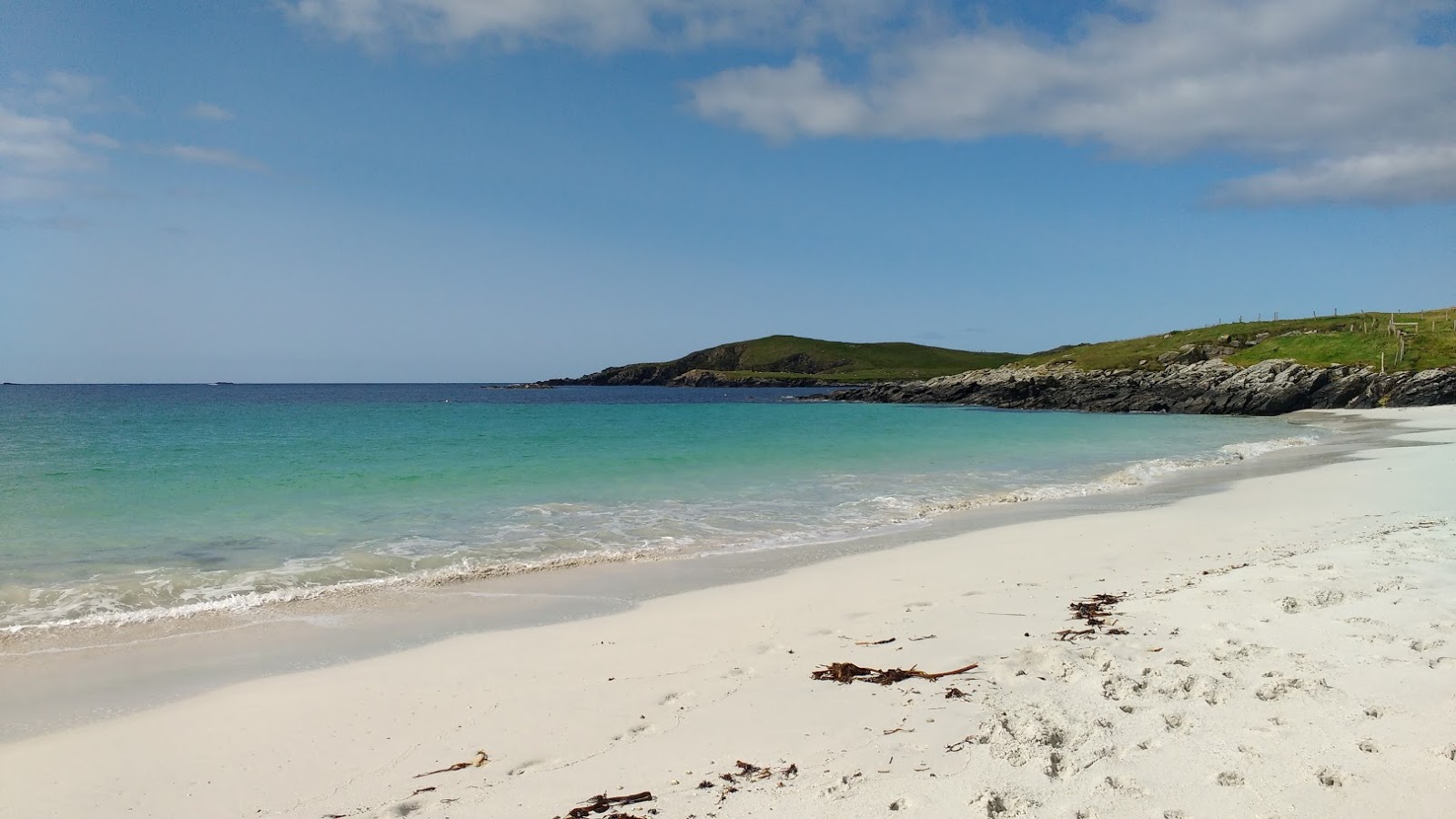
I then made my way to Meal Beach, on the island of Burra.  Absolutely gorgeous. I would love to have stayed longer, but it was four miles back and I wanted to catch the bus into Lerwick to meet the rest of my group and have one more browse among the yarn.  Oh yes, there was wool - lots of it!  But I will have to save that for another post.  In the meanwhile. just gaze on that turquoise blue.


Have I convinced you yet to book a trip to Shetland?

Tuesday, 8 August 2017

Sock Yarn Test. . .

I love testing new yarns, so when The Knitting Goddess posted that she had dyed a new base called Britsilk and was looking for feedback, I was very eager to give it a go.  Britsilk is made up of 40% Blue-Faced Leicester, 20% Wensleydale, 20% Alpaca ad 20% silk.  All the wool is British and it's spun and processed in the UK and then dyed by Joy.  She sent me a mini-skein of this bright rainbow colourway - very smooth and soft to the touch.


This blend is very similar to her Britsock range where the breed percentage is the same but instead of the silk, there is 20% nylon. While I would never use pure silk for socks, I am interested in non-nylon substitutes for typical sock yarn ( if you are too, check out Mrs M's Curiosity Cabinet blog and podcast here as Meg's embarked on a much more extensive experiment with non-nylon yarns) and so was curious to see how these would work for socks.  I didn't have enough for a full sock, but since holes first tend to appear around the toes, I knit this little toe cap.  It's a lovely yarn to knit with - runs very smoothly through your fingers and this photo doesn't really do justice to the  intense colour and shine of it. 


For my first test, I wore it inside another sock for a week and went about my daily life which involved several walks into work ( about three miles each).  At the end of the week, there was some agitation of the fibres where they had rubbed against each other, but no distinctive pills and more importantly no holes. On the left is the top part and the right, the sole, which has felted slightly.


Next, I tested it in my hiking boots, tucking it inside on the last two walks I did with my rambling group.  In total that was about 25 miles over two separate days, occasionally over some rough terrain and definitely in hot conditions.  My feet were certainly sweating and this toe cap got a good workout.  I then popped it into the washer and dryer. Here's how the top and sole looked when it came out. 


And the inside - as expected this has felted quite a bit, but again, no discernible signs of pilling on the outside and no holes at all.  I'm pretty impressed.


In conclusion, while most knitters I suspect will use this yarn for shawls and garments that need the lovely drape and luxury that silk brings, I do think it could also be used for socks as it seems to be as strong as any yarn with nylon in it.  It certainly felt wonderful on my foot and given the testing I've put it through, I think it's a credit to the wool fibres in this yarn that have given it the strength and stability that a sock needs.   One word of caution though - I made the silly mistake of not hand-washing this sample first before chucking it in the washer. As with many hand-dyed yarns, the dye can bleed on that first washing, so I've foolishly ruined three grey t-shirts.


Thursday, 3 August 2017

A Circular Walk in the Yorkshire Dales . .


Last Sunday we went on a lovely 14 mile circular walk from Grassington. Shall we just feast our eyes on the lovely green that is the Yorkshire Dales?


Hard to believe now, but this whole area was a hub of activity in the 19th century due to lead ore mining. You have to be careful not to stray from the paths as there are still mine shafts hidden beneath the turf.


A few ruins remain.

And the first bit of heather was out.


We returned via the Dales Way path which is just gorgeous.


It forms a great, green backdrop to photo this new hat I knit for the Liverpud.  I was test knitting for Blacker Yarns and the pattern for the Atoll hat will be out shortly.  It uses two strands of lace weight in a simple broken rib pattern.


Lots of wild flowers out too.


And back to Grassington where there are many lovely pubs and shops.